 +971 6 522 6368
  +971-56-994-6523
  info@resalahphysio.com

Sciatica
A Complete, Step-by-Step Patient Guide
If you have ever felt a sharp, electric, or shooting pain travel from your lower back straight down through your buttock and all the way into your leg or foot, you may be experiencing sciatica. Experiencing nerve pain can be deeply distressing, disruptive, and exhausting, especially when simple movements like sitting, standing, or putting on shoes trigger an agonizing jolt.
This guide is written in plain, empathetic, and easy-to-understand language specifically for you. Whether your pain started suddenly after a heavy lift or crept up gradually over weeks, this comprehensive manual will walk you through what the sciatic nerve does, what is happening inside your spine, how clinicians evaluate the problem, and how you can achieve lasting relief and healing.
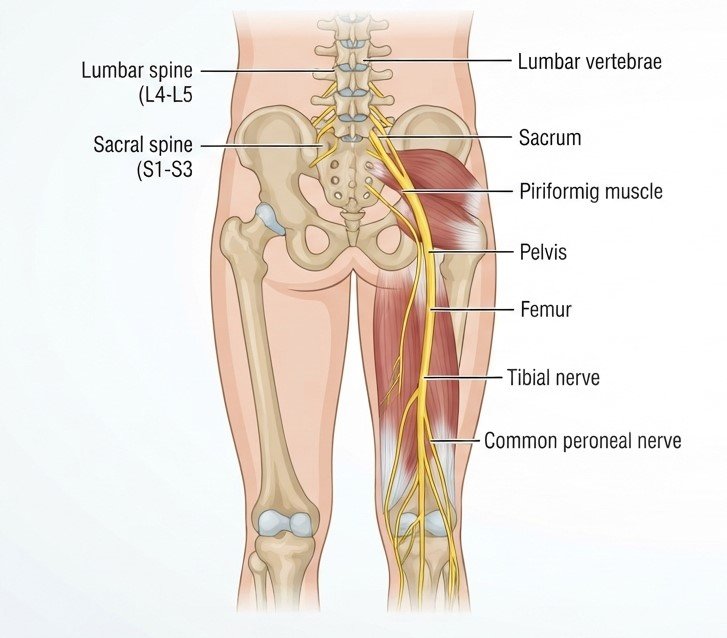
Table of Contents
- What is the Sciatic Nerve and What Does It Do?
- What Actually Happens When You Develop Sciatica?
- Common Causes and Risk Factors
- What Does Sciatica Feel Like? (Symptoms)
- The Different Types and Severity Levels of Sciatica
- How a Physiotherapist Evaluates Your Condition
- Immediate First Aid and Flare-Up Management
- Your Step-by-Step Rehabilitation Journey
- Common Myths About Sciatica Recovery
- Long-Term Prevention: Protecting Your Spine and Nerves
1. What is the Sciatic Nerve and What Does It Do?
Before understanding your pain, it helps to understand the anatomy involved. The sciatic nerve is the longest and thickest single nerve in your human body.
Anatomy: It is formed by the combination of several nerve roots that exit your lower spine (lumbar and sacral regions). These roots merge deep in your pelvis and run down through your buttocks, past the back of your knee, and branch out into your lower leg and foot.
Its Role: Your sciatic nerve acts as the primary electrical highway connecting your spinal cord to the muscles and skin of your lower limbs. It is responsible for sending movement signals to your leg muscles and relaying sensory information (like touch, temperature, and pain) back to your brain.
2. What Actually Happens When You Develop Sciatica?
Sciatica is not actually a medical diagnosis on its own; it is a symptom of an underlying issue that irritates, inflames, or compresses the sciatic nerve. Think of your nerve like an electrical cord plugged into a wall. If something heavy presses down on that cord, or if it gets stretched too tightly over a sharp edge, the electrical current malfunctions, sending painful static, sharp signals, or numbness down the line. When your sciatic nerve is compressed or inflamed: Pressure builds up around the nerve root as it exits the spine (often due to a bulging disc or tight surrounding tissues).
The delicate protective outer layer of the nerve becomes irritated, triggering localized inflammation and swelling.
The nerve responds by firing off distress signals that your brain interprets as sharp, burning, or shooting pain traveling all the way down the nerve pathway.
3. Common Causes and Risk Factors
Sciatica can be triggered by structural shifts in the spine or muscular tension deep in the hip.
Common Triggers
Lumbar Disc Herniation: The most frequent cause. The soft, gel-like cushion between your spinal bones pushes outward and presses directly against the adjacent nerve root.
Spinal Stenosis: A narrowing of the spinal canal that puts pressure on the nerves traveling through the lower back.
Piriformis Syndrome: The piriformis muscle deep in your buttock spasms or tightens excessively, squeezing the sciatic nerve as it passes underneath or right through it.
Degenerative Disc Disease: Natural wear and tear of spinal discs over time, leading to inflammation and nerve irritation.
Hidden Risk Factors (Why it happened to you)
Sedentary Lifestyle: Spending long hours sitting weakens your core and gluteal muscles, leaving your lower spine unsupported.
Poor Lifting Mechanics: Lifting heavy objects with a rounded back instead of bending your knees and engaging your hips.
Pregnancy: Weight distribution changes, shifting posture, and relaxin hormones can put extra stress on the lower spine and pelvis.
4. What Does Sciatica Feel Like? (Symptoms)
Sciatica usually affects only one side of your body at a time. The sensations can vary dramatically from person to person: Shooting or Burning Pain: A sharp, electric shock-like sensation running from your lower back or buttock down the back of your thigh and into your calf or foot.
Numbness and Tingling: A “pins and needles” sensation or a feeling of deadened feeling in your leg or toes.
Muscle Weakness: Difficulty lifting your foot (sometimes called foot drop), standing on your tiptoes, or feeling like your leg might “give out” beneath you.
Pain That Worsens with Movement: Agony when coughing, sneezing, laughing, or sitting in a car or office chair for extended periods.
5. The Severity Levels of Sciatica
Medical professionals evaluate nerve compression based on how intensely it impacts your daily functioning:
Mild Sciatica:
Intermittent tingling or mild dull ache in the buttock and back of the thigh. You can still walk and work, though it feels uncomfortable.
Moderate Sciatica:
Consistent burning pain that interferes with sitting, walking, and sleeping. A noticeable limp may develop, and everyday tasks require conscious effort.
Severe Sciatica:
Excruciating, unremitting pain accompanied by significant muscle weakness, sensory loss, or bladder/bowel changes. (Note: Loss of bladder or bowel control is a medical emergency requiring immediate attention).
6. How a Physiotherapist Evaluates Your Condition
When you visit a specialized clinic, your physiotherapist conducts a thorough physical evaluation to pinpoint the exact source of your nerve irritation: Detailed History: Asking about when the pain started, what positions make it better or worse, and whether you experience numbness or weakness. Neurological Screening: Testing your deep tendon reflexes, muscle strength, and skin sensation in both legs to check for nerve signal interference.
Orthopedic and Mobility Tests: Performing gentle movements, such as the Straight Leg Raise test, to reproduce and isolate the tension on your sciatic nerve safely.
7. Immediate First Aid and Flare-Up Management
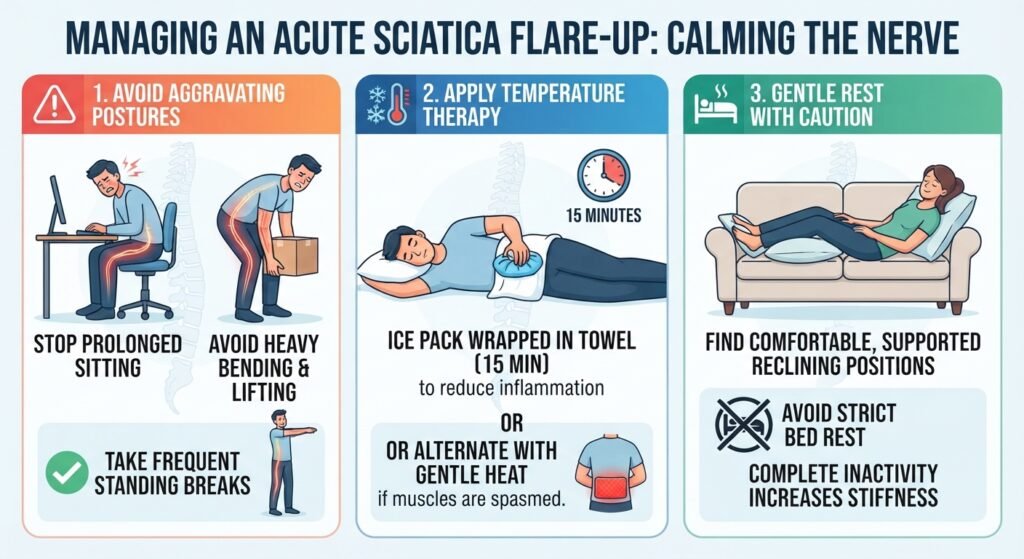
When sciatica flares up sharply, your primary goal is to calm the irritated nerve down:
Avoid Aggravating Postures: Stop prolonged sitting or heavy bending that pinches the nerve. Take frequent standing breaks.
Apply Temperature Therapy: Use an ice pack wrapped in a towel for 15 minutes to reduce acute nerve inflammation, or alternate with gentle heat if your muscles are severely spasmed.
Gentle Rest with Caution: Avoid strict bed rest, as complete inactivity can make spinal stiffness worse. Instead, find comfortable, supported reclining positions.
8. Your Step-by-Step Rehabilitation Journey
Targeted physiotherapy is proven to be one of the most effective non-surgical treatments for long-term sciatica relief:
Phase 1: Pain Modulation and Nerve Decompression
Gentle unloading techniques and specific directional preference exercises (such as gentle extension movements if a disc is involved) to move pressure away from the nerve root.
Soft tissue therapy to relieve tight hip and lower back muscles.
Phase 2: Mobility and Core Stabilization
Nerve gliding (neurodynamic) exercises to help the sciatic nerve move freely and smoothly through surrounding tissues without friction.
Building foundational core stability (transversus abdominis and deep spinal muscles) to act as a natural back brace.
Phase 3: Functional Strengthening and Posture Correction
Strengthening your glutes, hamstrings, and spinal erectors to share the mechanical load of daily activities.
Postural education and ergonomic training for sitting, driving, and lifting to protect your spine moving forward.
9. Common Myths About Sciatica Recovery
Myth 1: “If I have sciatica, I need complete bed rest until it goes completely away.”
Truth: Prolonged bed rest weakens your core and slows down recovery. Gentle, guided movement under professional supervision speeds up nerve healing.
Myth 2: “Stretching my hamstring aggressively will cure my sciatica.”
Truth: Aggressively stretching a sciatic nerve that is already mechanically irritated can increase tension and worsen inflammation. Nerve care requires precise, specialized techniques.
Myth 3: “Surgery is always required to fix a pinched nerve.”
Truth: The vast majority of sciatica cases resolve successfully with non-surgical physiotherapy, core rehabilitation, and time.
10. Long-Term Prevention: Protecting Your Spine and Nerves
To keep sciatica from returning, integrate these habits into your daily lifestyle:
Strengthen Your Core: Keep your abdominal and back muscles strong to support your spine during daily tasks.
Practice Good Ergonomics: Adjust your workspace chair, use lumbar support cushions, and avoid slouching.
Lift with Care: Always bend at your knees and hips—never your waist—when picking up heavy items.
Stay Active Daily: Regular walking and low-impact movement keep your spinal discs nourished and flexible.
How Al Resalah Medical Center Can Help You Heal
Navigating sciatic nerve pain can be exhausting, unpredictable, and severely limiting. Trying to push through sharp nerve pain or relying solely on temporary quick fixes can prolong your suffering and risk recurring flare-ups.
At Al Resalah Medical Center, our expert clinical team provides thorough, one-of-a-kind evaluations to identify the exact origin of your nerve compression and design a personalized rehabilitation program tailored specifically to your spine and lifestyle.
Under the expert care of our specialists, including Mr. Majid Husain, Senior Neuro Physiotherapist, we guide you step-by-step from acute pain relief and nerve decompression all the way through core stabilization, functional strengthening, and long-term spinal health.
Don’t let sciatica dictate your daily routine or steal your mobility. Schedule a consultation at Al Resalah Medical Center today and take your first confident step toward a pain-free, active life.
Meet Our Lead Neuro Physiotherapist

Majid Husain, MPT
MPT Neuro Science | MOH Licensed Physiotherapist | 10+ Years Experience
Majid Husain is a highly qualified and compassionate Senior Neuro Physiotherapist with over 10 years of experience in neuro rehabilitation, spine rehabilitation, and functional recovery. He completed his Bachelor’s degree in Physiotherapy from H.N.B Garhwal Central University, India in 2014 and later earned his Master of Physiotherapy (MPT) in Neuro Science in 2019.
Before joining Al Resalah Medical Center, Majid gained valuable clinical experience at BLK Super Speciality Hospital in India, where he worked with patients suffering from complex neurological and musculoskeletal conditions.
🌟 “Majid Husain follows a patient-centered neuro rehabilitation approach focused on improving mobility, independence, balance, and overall quality of life through evidence-based physiotherapy and compassionate care.”
🎯 Every rehabilitation program is carefully personalized based on the patient’s neurological condition, functional goals, mobility level, and recovery progress. Our neuro physiotherapy sessions focus on safe recovery, measurable improvement, and long-term functional independence.