 +971 6 522 6368
  +971-56-994-6523
  info@resalahphysio.com

Groin Strain
A Complete, Step-by-Step Patient Guide
If you just felt a sudden sharp pull, ache, or stabbing pain in your inner thigh or groin area while running, kicking, changing directions, or skating, you may have injured your adductor muscles. Experiencing a groin injury can be painful and frustrating, making everyday movements like walking or stepping out of a car feel daunting.
This guide is written in plain, easy-to-understand language specifically for you. Whether you are dealing with a mild pull or a more significant tear, this comprehensive manual will walk you through what your groin muscles do, what happened inside your leg, how physiotherapists evaluate the injury, and how you can heal completely with expert care.
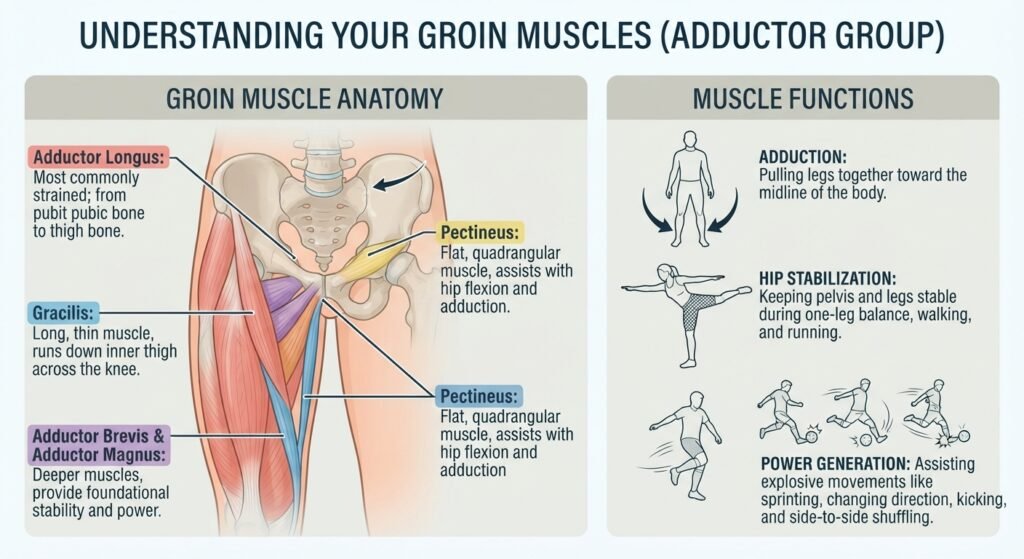
Table of Contents
- What is a Groin Muscle and What Does It Do?
- What Actually Happens When You Injure Your Groin?
- Common Causes and Risk Factors
- What Does a Groin Strain Feel Like? (Symptoms)
- The 3 Grades of Groin Strains
- How a Physiotherapist Diagnoses Your Injury
- Immediate First Aid: The RICE Protocol
- Your Step-by-Step Rehabilitation Journey
- Common Myths About Groin Recovery
- Long-Term Prevention: How to Stop It From Happening Again
- Professional Care at Al Resalah Medical Center
1. What is a Groin Muscle and What Does It Do?
Before understanding the injury, it helps to know what is happening underneath your skin. Your “groin muscles”—medically known as the adductor muscle group—are a collection of muscles located on the inside of your thigh. This group includes:
Adductor Longus: The most commonly strained muscle, running from your pubic bone down to your thigh bone.
Gracilis: A long, thin muscle running down the inner thigh across the knee.
Adductor Brevis & Adductor Magnus: Deeper muscles providing foundational stability and power.
Pectineus: A flat, quadrangular muscle assisting with hip flexion and adduction.
What they do for you:
Adduction: Pulling your legs together toward the midline of your body.
Hip Stabilization: Keeping your pelvis and legs stable when you balance on one leg, walk, or run.
Power Generation: Assisting in explosive movements like sprinting, changing direction, kicking a ball, or side-to-side shuffling.
2. What Actually Happens When You Injure Your Groin?
When people say they “strained” or “pulled” their groin, they mean that one or more of the adductor muscle fibers or tendons were stretched beyond their mechanical limits.
Think of your muscle fibers like a sturdy bundle of elastic resistance bands. If you stretch them slowly and smoothly, they respond gracefully. But if you force them apart too quickly or apply heavy resistance while they are lengthening, some or many of those fibers will overstretch, micro-tear, or rupture entirely.
When those fibers tear:
Sensory Alert: Your body immediately senses tissue damage and dispatches chemical warning signals.
Inflammation: These chemicals trigger localized inflammation, swelling, and sharp pain to guard the area against further movement.
Bruising: If small blood vessels rupture alongside the muscle fibers, blood leaks into the surrounding tissue, creating tenderness, discoloration, and bruising down the inner thigh.
3. Common Causes and Risk Factors
Groin strains usually happen during explosive, high-speed movements, but they can also develop gradually from repetitive stress.
Common Triggers
Kicking Sports: Soccer, football, rugby, and martial arts, where powerful kicking or sudden side-foot trapping places immense stress on the inner thigh.
Sudden Changes of Direction: Cutting, pivoting, or sliding on turf or court surfaces (such as tennis, basketball, or hockey).
Rapid Acceleration and Sprinting: Pushing off explosively from a stationary position.
Deep Over-Stretching: Slipping on a wet floor, doing wide splits, or being forced into an extreme outer range of motion.
Hidden Risk Factors (Why it happened to you)
Muscle Imbalances: If your core, glutes, or abductors are weak, your adductors are forced to compensate, overloading the inner thigh.
Previous Injury: A groin strain that healed with stiff scar tissue is significantly more vulnerable to re-injury.
Inadequate Warm-Up: Jumping straight into high-intensity sports without dynamic inner-thigh mobilization.
4. What Does a Groin Strain Feel Like? (Symptoms)
No two injuries are exactly alike, but most people experience a combination of the following signs:
The Sudden Sharp Sting: A sharp, stabbing pain or pulling sensation in the inner thigh at the exact moment of injury.
Pain with Movement: Difficulty squeezing your legs together, walking, lifting your knee, or stepping sideways.
Local Tenderness: Soreness when pressing directly along the pubic bone or the inner thigh muscle belly.
Swelling and Stiffness: A deep feeling of tightness or restricted motion in the hip joint, sometimes accompanied by swelling or bruising days later.
5. The 3 Grades of Groin Strains
Medical professionals classify groin strains into three distinct categories based on structural damage:
Grade 1: Mild Strain (The Pull)
What it is: A few muscle fibers are overstretched or micro-torn; overall muscle integrity remains intact.
How it feels: Mild discomfort or tightness in the inner thigh. You can usually walk normally, though fast movements may tweak the area.
Recovery Time: 1 to 3 weeks.
Grade 2: Moderate Strain (Partial Tear)
What it is: A substantial number of muscle fibers are torn, creating a partial tear within the muscle or tendon junction.
How it feels: Moderate to severe pain, sharp sting when attempting to squeeze the legs together, noticeable swelling, and a distinct limp while walking.
Recovery Time: 3 to 6 weeks.
Grade 3: Severe Strain (Complete Rupture)
What it is: The muscle or tendon has torn completely across, or pulled away from the pelvic bone.
How it feels: Excruciating pain at the moment of injury, severe swelling, extensive bruising, and an inability to bear weight or contract the muscle.
Recovery Time: 6 to 12 weeks (or longer), sometimes requiring specialized medical co-management.
6. How a Physiotherapist Diagnoses Your Injury
When you visit a clinic, your physiotherapist acts like a clinical detective to pinpoint the exact source of your pain:
Detailed History: Asking questions about how the injury occurred, the exact location of the pain, and your activity goals.
Physical Examination: Gently palpating (feeling) the inner thigh and pelvic attachment points to evaluate tenderness, gaps, or swelling.
Resisted and Passive Testing: Moving your hip into specific positions and asking you to resist or push against their hand to test adductor strength and range of motion.
7. Immediate First Aid: The RICE Protocol
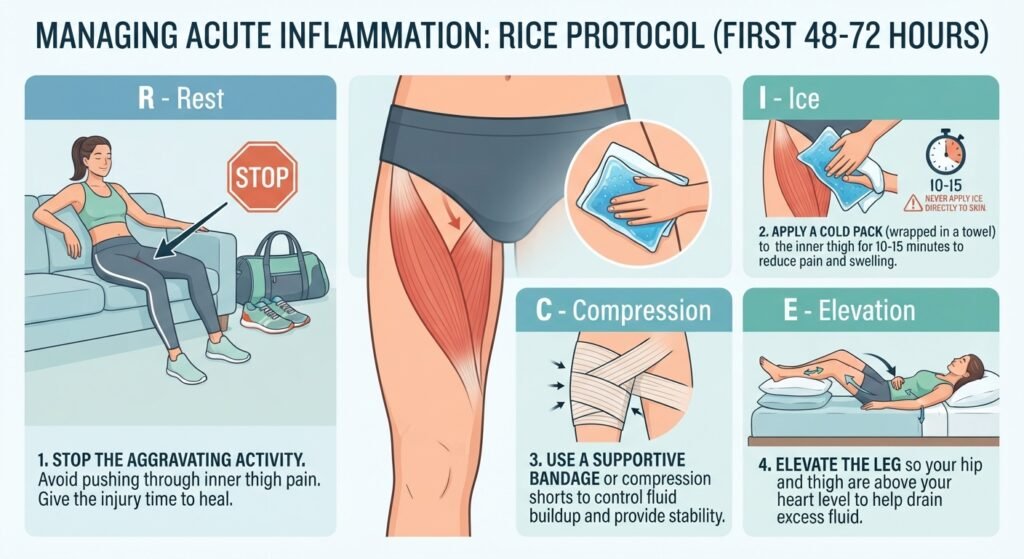
If you just got injured, managing acute inflammation during the first 48 to 72 hours is critical. Remember the acronym RICE:
R – Rest: Stop the aggravating activity immediately. Avoid pushing through inner thigh pain.
I – Ice: Apply a cold pack wrapped in a damp towel to the inner thigh for 10 to 15 minutes at a time to reduce pain and numb acute swelling. (Never apply raw ice directly to the skin.)
C – Compression: Use a supportive elastic bandage or compression shorts designed for the groin to control internal fluid buildup and provide stability.
E – Elevation: Rest comfortably with your leg supported so that your hip and thigh are elevated, helping drain excess fluid away from the injury site.
Your Step-by-Step Rehabilitation Journey
Recovering on your own without professional guidance is the primary reason groin injuries become chronic. A structured rehabilitation program ensures complete healing:
Phase 1: Pain Relief and Tissue Settling
Focuses on gentle movement, reducing acute inflammation, utilizing electrotherapy to calm muscle spasms, and gentle joint mobilization to maintain safe hip range of motion.
Phase 2: Progressive Stretching and Strengthening
Once initial inflammation subsides, your physiotherapist introduces gradual, pain-free stretching and isometric strengthening to rebuild baseline tissue resilience and prevent stiff scar tissue formation.
Phase 3: Functional and Agility Training
Advanced rehabilitation introduces multi-directional movement, core stability exercises, and functional training programs tailored specifically to your sport or daily routine to safely prepare you for full activity.
9. Common Myths About Groin Recovery
Myth 1: “I should stretch my groin aggressively right away to loosen the stiffness.”
Truth: Stretching a freshly torn muscle disrupts delicate healing fibers and worsens the tear. Always follow your physiotherapist’s timeline for flexibility work.
Myth 2: “Once the sharp pain stops, I am fully healed.”
Truth: Pain disappears long before tensile strength is restored. Stopping rehab early dramatically increases your risk of re-injury.
Myth 3: “Groin strains always heal completely on their own with complete bed rest.”
Truth: Complete inactivity leads to muscle atrophy and weak scar tissue formation. Guided, progressive physiotherapy is essential for proper recovery.
10. Long-Term Prevention: How to Stop It From Happening Again
Listen to Your Body: Never push through sharp inner thigh discomfort or tightness. If it hurts, pause and rest.
Wear Supportive Clothing: During high-risk athletic seasons, supportive compression wear or specialized groin wraps can provide reassuring stability.
Stay Active Safely: Maintain cardiovascular fitness with low-impact alternatives like walking or swimming while your injury heals.
Eat a Healthy Diet: Ensure adequate protein intake and balanced nutrition to supply your body with the building blocks necessary for tissue repair.
Professional Care at Al Resalah Medical Center
Recovering from a groin strain can be frustrating and disruptive, but you do not have to navigate it alone. Following the wrong protocol or rushing back to activity too quickly can trap you in a painful cycle of recurring setbacks.
At Al Resalah Medical Center, our expert clinical team provides thorough, one-on-one evaluations to accurately grade your injury and design a customized rehabilitation program tailored specifically to your body, lifestyle, and athletic goals.
Under the expert care of our specialists, including Mr. Shamshad Ali, Senior Sports Physiotherapist, we guide you step-by-step from acute pain relief and RICE protocols through electrotherapy, joint mobilization, progressive strengthening, and advanced functional training.
Don’t let a groin strain sideline your life or your favorite activities. Schedule an appointment at Al Resalah Medical Center today and take your first confident step toward a complete, safe recovery.
Meet Our Lead Sports Physiotherapist

Shamshad Ali, MPT
Sr. Sports Physiotherapist
SHA Licensed | 10+ years experience
Shamshad Ali is a highly experienced Senior Sports Physiotherapist with over 10 years of clinical experience in musculoskeletal and sports injury rehabilitation. He is certified in advanced rehabilitation and ANF therapy techniques. He graduated from HNB Garhwal University in 2014 and further refined his clinical expertise at GB Pant Hospital, Delhi.
🌟 “Shamshad’s patient-first approach integrates hands-on therapy with compassionate athlete education — ensuring every athlete reaches functional milestones.”
🎯 Our evidence-based sports rehabilitation programs focus on pain relief, mobility restoration, strength recovery, injury prevention, and safe return to sports activities.