 +971 6 522 6368
  +971-56-994-6523
  info@resalahphysio.com

Rotator Cuff Tears
A Complete, Step-by-Step Patient Guide
If you just felt a sudden sharp pain, a dull ache deep inside your shoulder, or a snapping sensation while lifting your arm, reaching overhead, or sleeping on your side, you might have injured your rotator cuff. Experiencing shoulder pain can be frustrating and debilitating, especially since your upper extremities are involved in almost every daily movement.
This guide is written in plain, easy-to-understand language specifically for you. Whether you are dealing with a mild tendinopathy or a severe full-thickness tear, this comprehensive manual will walk you through what your rotator cuff does, what happened inside your shoulder joint, how doctors and physiotherapists figure out the problem, and how you can heal completely.
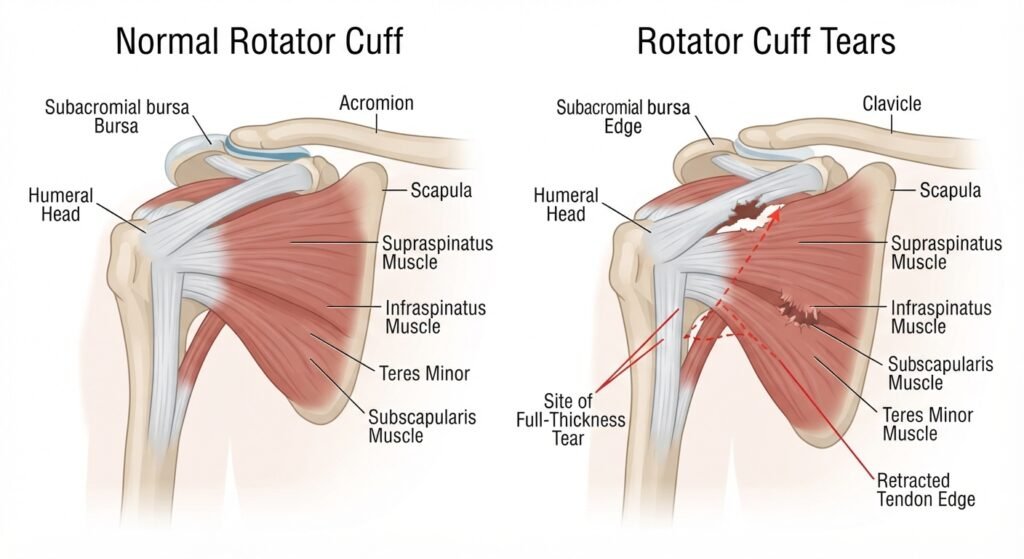
Table of Contents
What is the Rotator Cuff and What Does It Do?
What Actually Happens When You Tear Your Rotator Cuff?
Common Causes and Risk Factors
What Does a Rotator Cuff Tear Feel Like? (Symptoms)
The Grades and Types of Rotator Cuff Tears
How a Physiotherapist Diagnoses Your Injury
Immediate First Aid and Acute Management
Your Step-by-Step Rehabilitation Journey
Common Myths About Rotator Cuff Recovery
Long-Term Prevention: How to Protect Your Shoulders
Professional Care at Al Resalah Medical Center
1. What is the Rotator Cuff and What Does It Do?
Recovering from a rotator cuff tear can feel frustrating and overwhelming, but you do not have to navigate it alone. Following the wrong exercise protocol or rushing back to overhead activities too quickly can trap you in a painful cycle of chronic impingement and tendon degeneration.
At Al Resalah Medical Center, our expert clinical team provides thorough, one-on-one evaluations to accurately grade your shoulder injury and design a customized rehabilitation program tailored specifically to your body and lifestyle.
Under the expert care of our specialists, including Mr. Shamshad Ali, Sports Physiotherapist, we guide you step-by-step from acute pain relief, manual therapy, and cryotherapy management all the way through advanced strengthening, proprioceptive drills, and full functional recovery.
Don’t let a shoulder injury sideline your life, your sleep, or your favorite activities. Schedule an appointment at Al Resalah Medical Center today and take your first confident step toward a complete, safe recovery.
2. What Actually Happens When You Tear Your Rotator Cuff?
When people say they have a “rotator cuff tear,” they mean that one or more of these tendons have frayed, thinned, or pulled completely away from the bone where they attach.
Think of your shoulder tendons like a heavy-duty woven tow strap. Over years of friction, repetitive overhead strain, or acute trauma, individual strands of that woven strap begin to fray. If the stress continues, a partial tear develops where the strap is thinned out. In severe cases, the entire strap snaps completely in half (a full-thickness tear), creating a gap where the arm bone loses its primary tether.
When these fibers tear:
Inflammatory Response: Your body immediately sends out chemical mediators and white blood cells to clean up damaged tissue, triggering localized inflammation, heat, and pain.
Biomechanical Disruption: Without the stabilizing pull of the torn tendon, larger muscles pull the upper arm bone upward abnormally, causing friction against the bone arch above it (subacromial impingement) and weakening your overall lifting power.
3. Common Causes and Risk Factors
Rotator cuff injuries generally fall into two categories: acute trauma (sudden accidents) and chronic degeneration (wear and tear over time).
Common Triggers
Heavy Lifting or Jerks: Trying to catch a heavy falling object or lifting excessive weight with poor form during exercises like overhead presses or bench presses.
Acute Falls: Falling directly onto an outstretched arm or landing heavily on the shoulder joint.
Repetitive Overhead Work or Sports: Activities that require constant arm elevation—such as painting, carpentry, swimming, tennis, baseball, or weight training—gradually wear down the tendon tissue.
Hidden Risk Factors (Why it happened to you)
Age-Related Degeneration: As we age past 40, the blood supply to the rotator cuff tendons naturally decreases, making the tissue less elastic and more vulnerable to microscopic tearing.
Bone Spurs (Subacromial Spurs): Extra bone growth on the underside of the acromion (shoulder blade roof) can physically rub against and abrade the tendon every time you raise your arm.
Poor Posture and Scapular Dysthymia: Rounded shoulders and a forward head posture alter the mechanics of the shoulder blade, narrowing the space where the rotator cuff tendons travel and pinching them under bone.
4. What Does a Rotator Cuff Tear Feel Like? (Symptoms)
No two injuries are exactly alike, but most people experience a combination of the following signs:
Deep, Dull Ache: A persistent, throbbing pain deep inside the shoulder joint that often worsens at night, making it difficult to sleep on the affected side.
Pain with Overhead Movements: Sharp or catching pain when reaching up into a cupboard, brushing your hair, or putting on a jacket.
Arm Weakness: A noticeable inability to lift your arm away from your body or hold items out in front of you against resistance.
Crepitus and Clicking: A distinct clicking, popping, or grating sensation (crepitus) when moving your arm through specific angles.
Limited Range of Motion: Stiffness and restriction in how far you can rotate or elevate your arm.
5. The Grades and Types of Rotator Cuff Tears
Medical professionals classify rotator cuff injuries based on how deep and extensive the damage is:
1. Tendinopathy / Impingement (Pre-tear Stage)
What it is: The tendon is irritated, inflamed, or swollen from friction, but the structural fibers remain intact.
How it feels: Achy soreness after activity, mild stiffness, and discomfort during overhead reaches.
Recovery Time: Usually 2 to 4 weeks with activity modification and targeted therapy.
2. Partial-Thickness Tear
What it is: The tendon is frayed or partially torn, but it does not completely separate the tendon from the bone. It can occur on the underside (articular side) or the upper side (bursal side) of the tendon.
How it feels: Moderate pain, catching sensations, and localized weakness when lifting the arm.
Recovery Time: 6 to 12 weeks of structured rehabilitation.
3. Full-Thickness Tear
What it is: The tendon is split all the way through, creating an open gap or causing the tendon to completely detach from the humerus bone.
How it feels: Severe weakness (such as the inability to keep the arm raised if someone gently pushes it down), intense pain during initial injury that may transition into chronic deep ache, and significant loss of active motion.
Recovery Time: 3 to 6 months. While small full-thickness tears can heal remarkably well with specialized conservative physical therapy, large or complete tears in active individuals may occasionally require surgical repair followed by extended rehabilitation.
6. How a Physiotherapist Diagnoses Your Injury
When you visit a clinic, your physiotherapist will act like a detective to evaluate your shoulder mechanics. The diagnostic process includes:
Detailed History: Asking targeted questions: How did the pain start? Was there a specific injury or did it creep up slowly? Which exact movements provoke the pain? Does it wake you up at night?
Visual & Palpation Assessment: Inspecting your shoulder girdle for muscle wasting (atrophy), swelling, or postural misalignments, and gently pressing along the joint line to find tender spots.
Orthopedic Special Tests: Performing specific hands-on stress tests (such as the Neer test, Hawkins-Kennedy test, Drop-Arm test, and Empty Can test) to isolate which specific tendon among the four is injured.
Imaging Referral (If Needed): If a complete tear or severe structural detachment is suspected, your therapist may coordinate diagnostic imaging such as a musculoskeletal ultrasound or an MRI scan.
7. Immediate First Aid and Acute Management
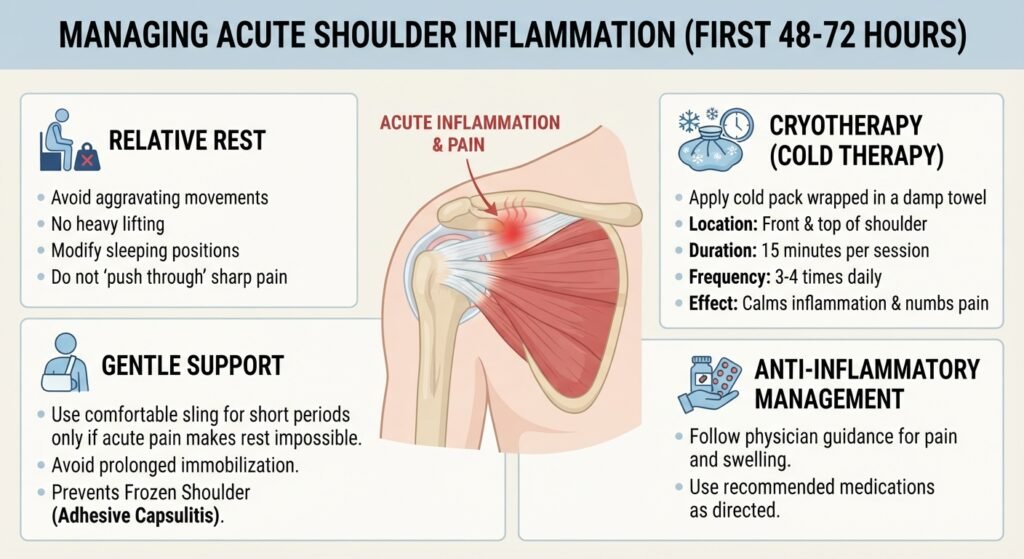
If you just experienced an acute shoulder injury, managing early inflammation is critical during the first 48 to 72 hours:
Relative Rest: Avoid the specific movements, heavy lifting, or sleeping positions that aggravate the pain. Do not try to “push through” a sharp tear.
Cryotherapy (Cold Therapy): Apply a cold pack wrapped in a damp towel to the front and top of your shoulder for 15 minutes at a time, 3 to 4 times a day, to calm acute inflammation and numb deep pain.
Gentle Support: Use a comfortable sling for short periods only if acute pain makes it impossible to rest your arm, but avoid prolonged immobilization to prevent frozen shoulder (adhesive capsulitis).
Anti-Inflammatory Management: Follow guidance from your physician regarding safe management of pain and swelling.
8. Your Step-by-Step Rehabilitation Journey
Physical therapy is the cornerstone of recovery for the vast majority of rotator cuff tears. Recovering on your own without professional guidance risks chronic stiffness or further tendon degradation.
Phase 1: Pain Relief, Modalities, and Gentle Mobility (Weeks 1 to 3)
Manual Therapy: Hands-on joint mobilizations, soft tissue massage, and gentle myofascial release performed by your physiotherapist to reduce protective muscle guarding, improve local blood flow, and restore passive range of motion.
Pendulum Exercises: Allowing your arm to hang completely limp while gently swinging your torso in small circles to use gravity to decompress the joint without activating torn muscles.
Passive Range of Motion (PROM): Using your uninjured arm, a pulley system, or a wand/stick to guide your injured arm through safe angles of movement.
Modalities: Application of cryotherapy or localized heat therapy to relax surrounding muscle spasms before movement.
Phase 2: Restoring Active Mobility and Proprioceptive Control (Weeks 3 to 6)
Active-Assisted Range of Motion (AAROM): Gradually engaging your own shoulder muscles while receiving assistance from your other arm or therapy bands to complete movements.
Proprioceptive Exercises: Retraining your nervous system’s awareness of joint position. This involves exercises performed with deliberate focus, closed eyes, or varied stable surfaces to reactivate the deep stabilizing muscles of the cuff.
Scapular Stabilization: Strengthening the muscles that anchor and move your shoulder blade (rhomboids, serratus anterior, lower trapezius) to create a solid mechanical foundation for your arm.
Phase 3: Targeted Strengthening and Resistance Training (Weeks 6 to 12+)
Isometric Loading: Contract your rotator cuff muscles against stationary resistance without moving the joint, safely stimulating tendon healing and strength gains without shear stress.
Resistance Band Training: Introducing light elastic bands for controlled external and internal rotation, rowing motions, and scaption exercises.
Progressive Weight Training: Gradually advancing to light dumbbells as tolerated, focusing on eccentric control (lowering weights slowly) to rebuild maximum tensile strength
Phase 4: Functional Integration and Return to Activity (Weeks 12 to 16+)
Sport- and Job-Specific Drills: Simulating the exact movement patterns required for your daily work tasks, overhead athletic throwing, racket sports, or weightlifting routines.
Neuromuscular Coordination: High-level dynamic stability drills ensuring your shoulder can handle sudden forces and unpredictable loads safely.
9. Common Myths About Rotator Cuff Recovery
Myth 1: “A torn rotator cuff always requires surgery to heal.”
Truth: Clinical research demonstrates that many partial- and even full-thickness tears can achieve full, pain-free functional recovery through expert physical therapy. Surgery is reserved for specific severe tears, young athletes with acute traumatic ruptures, or cases that do not respond to conservative care.
Myth 2: “If my shoulder hurts when I move it, I should keep it completely still in a sling.”
Truth: Prolonged immobilization causes rapid joint stiffness, scar tissue formation, and adhesive capsulitis (frozen shoulder). Controlled, guided movement is essential for healing tendons and maintaining joint health.
Myth 3: “Once my pain goes away, I can stop doing my rehab exercises.”
Truth: Pain relief indicates reduced inflammation, not complete tendon remodeling. Continuing your home exercise program is vital for long-term joint stability and preventing reinjury.
10. Long-Term Prevention: How to Protect Your Shoulders
Once you recover, incorporate these golden rules into your routine to keep your shoulders bulletproof:
Maintain Balanced Strength: Ensure your rotator cuff and scapular stabilizers are as strong as your large pushing muscles (chest and shoulders).
Prioritize Warm-Ups: Always spend 10 minutes performing dynamic shoulder mobility work and light rotator cuff activation before heavy lifting or sports.
Correct Posture: Keep your chest open and shoulders back during desk work, driving, and computer use to prevent chronic impingement mechanics.
Listen to Your Body: If you feel a sharp pinch or deep ache in your shoulder during a workout or repetitive task, stop and evaluate rather than pushing through the pain.
How Al Resalah Medical Center Can Help You Heal
Recovering from a rotator cuff tear can feel frustrating and overwhelming, but you do not have to navigate it alone. Following the wrong exercise protocol or rushing back to overhead activities too quickly can trap you in a painful cycle of chronic impingement and tendon degeneration.
At Al Resalah Medical Center, our expert clinical team provides thorough, one-on-one evaluations to accurately grade your shoulder injury and design a customized rehabilitation program tailored specifically to your body and lifestyle.
Under the expert care of our specialists, including Mr. Shamshad Ali, Sports Physiotherapist, we guide you step-by-step from acute pain relief, manual therapy, and cryotherapy management all the way through advanced strengthening, proprioceptive drills, and full functional recovery.
Don’t let a shoulder injury sideline your life, your sleep, or your favorite activities. Schedule an appointment at Al Resalah Medical Center today and take your first confident step toward a complete, safe recovery.
Meet Our Lead Sports Physiotherapist

Shamshad Ali, MPT
Sr. Sports Physiotherapist
SHA Licensed | 10+ years experience
Shamshad Ali is a highly experienced Senior Sports Physiotherapist with over 10 years of clinical experience in musculoskeletal and sports injury rehabilitation. He is certified in advanced rehabilitation and ANF therapy techniques. He graduated from HNB Garhwal University in 2014 and further refined his clinical expertise at GB Pant Hospital, Delhi.
🌟 “Shamshad’s patient-first approach integrates hands-on therapy with compassionate athlete education — ensuring every athlete reaches functional milestones.”
🎯 Our evidence-based sports rehabilitation programs focus on pain relief, mobility restoration, strength recovery, injury prevention, and safe return to sports activities.