 +971 6 522 6368
  +971-56-994-6523
  info@resalahphysio.com

Parkinson's Disease
A Complete, Step-by-Step Patient Guide
If you or a loved one has recently noticed a persistent tremor, a feeling of stiffness in your limbs, a slowing down of your daily movements, or subtle changes in your balance and walking pattern, you may be experiencing the early signs of Parkinson’s disease. Receiving a diagnosis or navigating neurodegenerative changes can feel overwhelming, frightening, and isolating, especially if you are unsure what the future holds.
This guide is written in plain, empathetic, and easy-to-understand language specifically for you and your family. Whether you are newly diagnosed or managing the condition long-term, this comprehensive manual will walk you through what Parkinson’s disease is, what is happening inside the brain, how doctors and physiotherapists evaluate the condition, and how you can reclaim your independence, mobility, and quality of life.
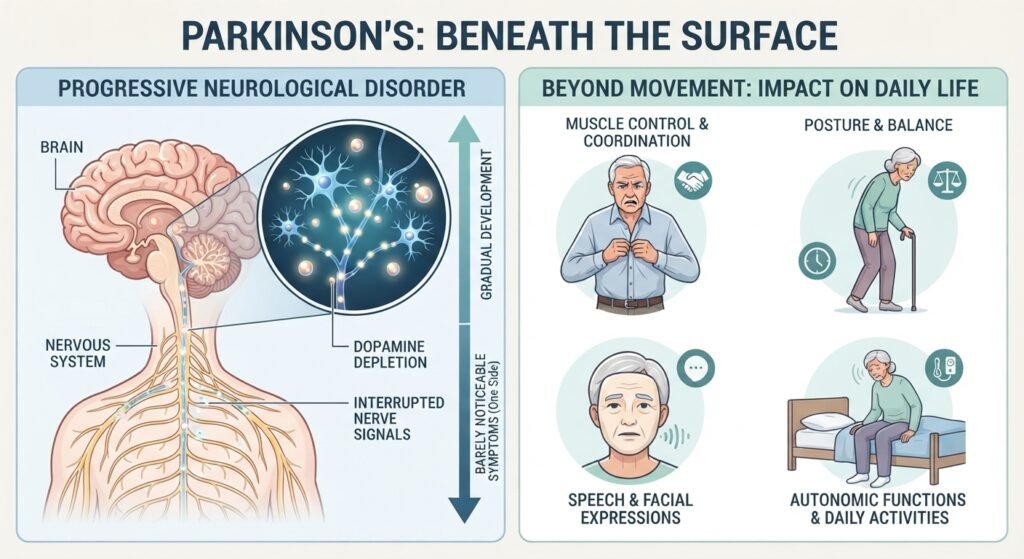
Table of Contents
What is Parkinson’s Disease and How Does It Affect the Body?
What Actually Happens Inside the Brain?
Common Causes, Triggers, and Risk Factors
What Does Parkinson’s Disease Feel Like? (Symptoms)
The Progression Stages of Parkinson’s Disease
How a Neuro-Physiotherapist Evaluates Your Condition
Immediate and Daily Self-Management Strategies
Your Step-by-Step Rehabilitation Journey
Common Myths About Parkinson’s Recovery and Exercise
Long-Term Management: Maintaining Independence and Preventing Falls
Professional Care at Al Resalah Medical Center
1. What is Parkinson's Disease and How Does It Affect the Body?
Before understanding how to manage the condition, it helps to understand what is happening beneath the surface. Parkinson’s disease is a progressive neurological disorder that primarily affects your nervous system and the parts of the body controlled by nerves.
While it is widely known as a movement disorder, its effects reach beyond simple muscle control. It influences your posture, balance, coordination, speech, facial expressions, and even autonomic functions. Because it develops gradually—often starting with barely noticeable symptoms on one side of the body—it impacts daily activities like buttoning a shirt, writing, walking, or getting out of a chair.
2. What Actually Happens Inside the Brain?
To understand why movement changes occur, think of your brain as a complex electrical and chemical command center.
The Dopamine Shortage: Deep inside your brain is a structure called the substantia nigra, which produces a vital chemical messenger called dopamine. Dopamine acts like smooth lubricating oil for your nervous system, allowing messages to travel efficiently so your body can move smoothly and automatically.
Cell Degeneration: In Parkinson’s disease, the dopamine-producing nerve cells in this area slowly break down and die. When dopamine levels drop significantly, the brain’s motor circuits can no longer send proper movement instructions to your muscles.
The Resulting Chaos: Without enough dopamine, muscle signals become delayed, uncoordinated, or locked up. This leads to the characteristic slowness, rigidity, and tremors associated with the condition.
3. Common Causes and Risk Factors
The exact root cause of Parkinson’s disease remains largely idiopathic (unknown) in most cases, but researchers have identified several contributing factors:
Age: Advancing age is the single greatest risk factor. While most people are diagnosed over the age of 60, early-onset Parkinson’s can occur in younger adults.
Genetics: In a small percentage of cases, specific genetic mutations or a strong family history play a direct role.
Environmental Triggers: Exposure to certain toxins, heavy metals, or rural living with pesticide exposure has been linked to a slightly higher risk in scientific studies.
Exacerbating Triggers (What Worsens Symptoms): Physical illness, extreme fatigue, emotional stress, anxiety, or missing medication doses can temporarily cause your Parkinson’s symptoms to flare up significantly.
4. What Does Parkinson's Disease Feel Like? (Symptoms)
Parkinson’s affects every individual uniquely, but most people experience a combination of motor and non-motor signs:
Resting Tremor: A rhythmic shaking that usually begins in a hand, finger, or limb, often most noticeable when the arm is resting at your side.
Bradykinesia (Slowness of Movement): Simple physical tasks take much longer. You may notice a smaller handwriting style (micrographia) or difficulty initiating movement.
Muscle Rigidity: Stiffness, tightness, or resistance in your limbs and trunk that can cause aching and limit your natural arm swing while walking.
Postural Instability and Balance Issues: Stooped posture, a feeling of imbalance, and difficulty recovering if you sway, leading to an increased risk of falls.
Freezing of Gait: A sudden, temporary inability to move your feet forward, often described as feeling like your shoes are glued to the floor when turning or passing through doorways.
Non-Motor Symptoms: Fatigue, sleep disturbances, changes in mood, and subtle cognitive shifts.
5. The Stages of Parkinson's Disease
Medical professionals frequently categorize the progression of Parkinson’s using clinical rating scales to track how symptoms impact daily life:
Early Stage (Stages 1 and 2):
Symptoms are mild and generally unilateral (affecting one side of the body) or bilateral. Daily tasks can still be performed independently, though minor inconveniences or postural changes may be noticed.
Mid Stage (Stages 3):
Considered mid-stage, balance impairment becomes more apparent, and bradykinesia slows down physical responses. Independence in daily activities is maintained, but movement requires more conscious effort.
Advanced Stage (Stages 4 and 5):
Symptoms are severe and limiting. Walking and standing often require a walker, cane, or wheelchair assistance, and full-time supportive care is typically needed for daily living.
6. How a Neuro-Physiotherapist Evaluates Your Condition
When you visit a specialized clinic, your neuro-physiotherapist conducts a thorough, compassionate assessment to map out your specific functional profile:
Detailed Clinical History: Asking about symptom onset, medication schedules (ON/OFF periods), fall history, and your specific personal goals (e.g., walking to the mosque, playing with grandchildren, cooking independently).
Neuromuscular & Functional Assessment: Evaluating your muscle tone, joint flexibility, tremor characteristics, posture, and coordination.
Gait and Balance Testing: Observing how you walk, turn around, stand up from a chair, and respond to gentle balance disturbances to identify fall risks.
7. Immediate and Daily Self-Management Strategies
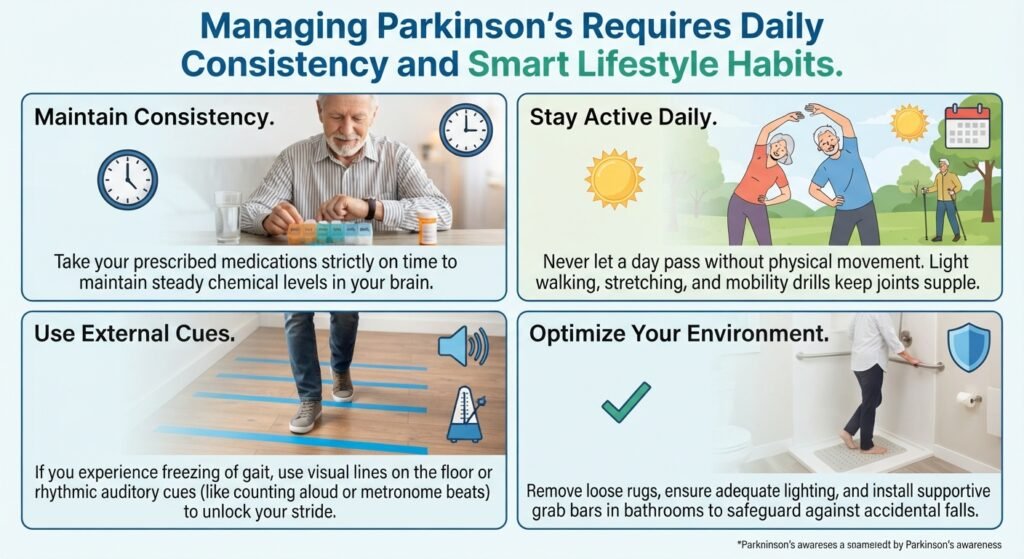
Managing Parkinson’s requires daily consistency and smart lifestyle habits:
Maintain Consistency: Take your prescribed medications strictly on time to maintain steady chemical levels in your brain.
Stay Active Daily: Never let a day pass without physical movement. Light walking, stretching, and mobility drills keep joints supple.
Use External Cues: If you experience freezing of gait, use visual lines on the floor or rhythmic auditory cues (like counting aloud or metronome beats) to unlock your stride.
Optimize Your Environment: Remove loose rugs, ensure adequate lighting, and install supportive grab bars in bathrooms to safeguard against accidental falls.
8. Your Step-by-Step Rehabilitation Journey
Neuroplasticity proves that your brain can rewire and adapt through targeted, consistent exercise. Specialized neuro-rehabilitation is your most powerful tool to slow functional decline:
Phase 1: Mobility, Flexibility, and Postural Realignment
Gentle stretching to combat muscle rigidity.
Spinal mobility exercises to reverse the tendency toward a stooped, forward-flexed posture.
Breathing exercises to expand the chest wall and improve vocal projection and respiratory capacity.
Phase 2: Strength, Balance, and Core Stability
Targeted strengthening of the lower limbs and core muscles to support upright posture.
Dynamic balance training, teaching your body to shift weight safely without losing stability.
Dual-task training (performing a physical movement while answering a question or counting) to improve cognitive-motor integration.
Phase 3: High-Amplitude and Functional Re-Training
Implementing large-amplitude movements (big steps, wide arm swings) to counteract the shrinking movements caused by bradykinesia.
Practicing complex real-world transitions, such as floor-to-stand recovery, turning safely, and stair climbing.
9. Common Myths About Parkinson's Recovery and Exercise
Myth 1: “Exercise will wear out my nervous system and make my tremors worse.”
Truth: Structured, high-intensity neuro-rehabilitation stimulates brain-derived neurotrophic factor (BDNF), protects nerve cells, and preserves functional independence. Exercise is medicine.
Myth 2: “Once balance issues start, there is nothing I can do to stop falls.”
Truth: Targeted balance training and vestibular-motor conditioning significantly improve postural stability and drastically reduce fall rates at any stage of the condition.
Myth 3: “Physiotherapy is only useful in the late stages of the disease.”
Truth: Starting neuro-physiotherapy immediately after diagnosis establishes vital baseline strength, prevents secondary joint contractures, and maximizes long-term mobility.
10. Long-Term Prevention of Complications: Staying Independent
To maintain your independence and safeguard your quality of life over the years:
Commit to Lifelong Movement: Treat daily exercise like a non-negotiable prescription.
Prioritize Fall Prevention: Regularly review your home environment and participate in ongoing balance maintenance programs.
Stay Socially and Mentally Engaged: Keep your mind active through hobbies, reading, social interaction, and continuous learning.
Professional Care at Al Resalah Medical Center
Navigating Parkinson’s disease can feel challenging, but you do not have to walk this path alone. Trying to manage neurological changes without expert guidance can lead to rapid deconditioning, stiffness, and increased safety risks.
Physiotherapy plays a vital role in the comprehensive treatment of Parkinson’s disease by helping manage symptoms, combat rigidity, and dramatically improve your daily quality of life. At Al Resalah Medical Center, our expert clinical team provides thorough, one-on-one neurological evaluations to design customized rehabilitation programs tailored specifically to your body, symptoms, and daily life aspirations—available both at our specialized clinic and directly through our home-care physiotherapy services.
Under the expert care of our specialists, including Mr. Majid Husain, Senior Neuro Physiotherapist, we guide you step-by-step through a comprehensive, evidence-based range of treatments designed to restore your independence:
Exercise Therapy: Regular physical exercise is crucial for managing Parkinson’s. Majid designs customized programs incorporating aerobic exercise, strength training, balance work, and stretching to improve muscle strength, flexibility, coordination, and overall vitality.
Gait Training: Because Parkinson’s can alter walking patterns—causing shuffling steps, reduced arm swing, and freezing—we assess and analyze your gait to provide tailored training that improves stride length, walking fluidity, and stability.
Balance Training: To combat impaired balance and reduce the risk of falls, our sessions include targeted exercises such as weight shifting, single-leg stance work, and specialized balance equipment training.
Range of Motion Exercises: To counter muscle stiffness and joint tightness, specific mobility exercises are prescribed to preserve and improve natural flexibility.
Posture and Alignment Correction: Addressing stooped or hunched postures common in Parkinson’s, we provide postural guidance and strengthening exercises for the core and back muscles that support an upright, confident stance.
Manual Therapy: Hands-on techniques including soft tissue manipulation, targeted joint mobilization, and assisted stretching are utilized to alleviate deep muscle stiffness and enhance free movement.
Assistive Devices Guidance: When necessary, we thoroughly assess your mobility needs and recommend appropriate assistive devices, such as canes or walkers, to ensure safe, independent navigation.
Education and Self-Management: We empower you and your family with in-depth education on Parkinson’s disease, teaching practical strategies like cueing and rhythmic exercises to smooth out movement initiation and coordination.
Don’t let Parkinson’s limit your freedom or define your lifestyle. Schedule a consultation at Al Resalah Medical Center today and take your first confident step toward empowered movement and renewed vitality.
Meet Our Lead Neuro Physiotherapist

Majid Husain, MPT
MPT Neuro Science | MOH Licensed Physiotherapist | 10+ Years Experience
Majid Husain is a highly qualified and compassionate Senior Neuro Physiotherapist with over 10 years of experience in neuro rehabilitation, spine rehabilitation, and functional recovery. He completed his Bachelor’s degree in Physiotherapy from H.N.B Garhwal Central University, India in 2014 and later earned his Master of Physiotherapy (MPT) in Neuro Science in 2019.
Before joining Al Resalah Medical Center, Majid gained valuable clinical experience at BLK Super Speciality Hospital in India, where he worked with patients suffering from complex neurological and musculoskeletal conditions.
🌟 “Majid Husain follows a patient-centered neuro rehabilitation approach focused on improving mobility, independence, balance, and overall quality of life through evidence-based physiotherapy and compassionate care.”
🎯 Every rehabilitation program is carefully personalized based on the patient’s neurological condition, functional goals, mobility level, and recovery progress. Our neuro physiotherapy sessions focus on safe recovery, measurable improvement, and long-term functional independence.
Insurance & Payment Options
We work with leading insurance providers to make quality healthcare accessible. Contact us to verify your coverage.










Don’t see your insurance provider? We accept many more. Call us to verify your coverage.